


Page 66 - 同步輻射-全
P. 66
064


              (a)                            (b)                            (c)                                                                                                                                                           Energy Science


     ACTIVITY REPORT  2016


              (d)                                      (e)                      (f)


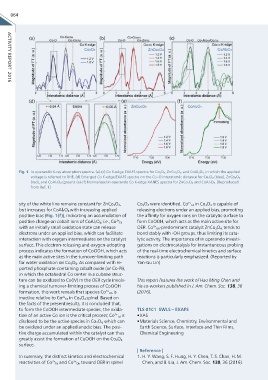
         Fig. 1:  In operando X-ray absorption spectra. (a)-(c) Co K-edge EXAFS spectra for Co3O4, ZnCo2O4, and CoAl2O4, in which the applied
               voltage is referred to RHE. (d) Enlarged Co K-edge EXAFS spectra on the Co–O interatomic distance for Co3O4 (blue), ZnCo2O4
               (red), and CoAl2O4 (green). (e)-(f) Normalized in operando Co K-edge XANES spectra for ZnCo2O4 and CoAl2O4. [Reproduced
               from Ref. 1]


          sity of the white line remains constant for ZnCo 2O 4,   Co 3O 4 were identified. Co 2+ Td in Co 3O 4 is capable of
          but increases for CoAl 2O 4 with increasing applied   releasing electrons under an applied bias, promoting
          positive bias (Fig. 1(f)), indicating an accumulation of   the affinity for oxygen ions on the catalytic surface to
          positive charge on cobalt ions of CoAl 2O 4; i.e., Co 2+ Td   form CoOOH, which acts as the main active site for
          with an initially small oxidation state can release   OER. Co 3+ Oh-predominant catalyst ZnCo 2O 4, tends to
          electrons under an applied bias, which can facilitate   bond stably with -OH groups, thus limiting its cata-
          interaction with oxygen intermediates on the catalyst   lytic activity. The importance of in operando investi-
          surface. This electron-releasing and oxygen-adopting   gations on electrocatalysis for instantaneous probing
          process indicates the formation of CoOOH, which acts   of the real-time electrochemical kinetics and surface
          as the main active sites in the turnover-limiting path   reactions is particularly emphasized. (Reported by
          for water oxidation on Co 3O 4. As compared with re-  Yan-Gu Lin)
          ported phosphate-containing cobalt oxide (or Co-Pi),
          in which the octahedral Co center in a cubane struc-
          ture can be oxidized to Co(IV) in the OER cycle involv-  This report features the work of Hao Ming Chen and
          ing a chemical turnover-limiting process of CoOOH   his co-workers published in J. Am. Chem. Soc. 138, 36
          formation, this work reveals that species Co 3+ Oh is   (2016).
          inactive relative to Co 2+ Td in Co 3O 4 spinel. Based on
          the facts of the present results, it is concluded that,
          to form the CoOOH intermediate species, the oxida-  TLS 01C1  SWLS – EXAFS
          tion of an active Co ion is the critical process; Co 2+ Td is   • XAS
          disclosed to be the active species in Co 3O 4, which can   • Materials Science, Chemistry, Environmental and
          be oxidized under an applied anodic bias. The posi-  Earth Science, Surface, Interface and Thin Films,
          tive charge accumulated within the catalyst can thus   Chemical Engineering
          greatly assist the formation of CoOOH on the Co 3O 4
          surface.
                                                              | Reference |
          In summary, the distinct kinetics and electrochemical   1. H. Y. Wang, S. F. Hung, H. Y. Chen, T. S. Chan, H. M.
          reactivities of Co 2+ Td and Co 3+ Oh toward OER in spinel   Chen, and B. Liu, J. Am. Chem. Soc. 138, 36 (2016).

